 |
 |
Klaus Doldinger |
|
|
Klaus Doldinger |
| The text and picture beyond come from
the GEMA-News 153 designed by Weisshuhn & Weisshuhn GbR, Berlin. I copied this because it is very well done and I have nothing to add. All soundtracks by Mr. Dolginger you find at the IMDB. |
|
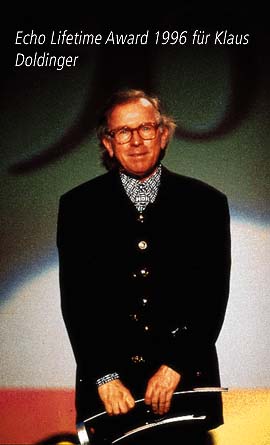
On 12th May, Klaus Doldinger was 60 years old. As musician, bandleader and composer, he has written German and international jazz history and with his film, television and stage music at the same time set international standards for high-class light music. On his birthday he received the Gold Disc for his music to the film Das Boot (The Boat); this year's birthday also coincides with the 25th anniversary of his legendary band, Passport.
Doldinger has some 2000 musical works with GEMA and, in numerous positions, being also on the Board of Supervisors since 1990, has for many years been active for GEMA and his fellow musicians.
by Folkhard Oelwein
There had never been anything like this in the venerable baroque "Asamsaal" of the Upper Bavarian cathedral city of Freising until this March day in the year 1963. On the stage a Hammond organ, onto which the young jazz organist, Ingfried Hofmann, pounced like a tiger, literally tearing his be-bop phrases out of the stops, whirling them on the furious staccato of his noisy chords into the numbed audience..
Blues for you was the name of that magnificent slaughtering of hard bop and next to the Hammond organ stood a slim, blond young man in an almost inappropriate, discreet pose, whom one would never have credited with the unbelievably thrusting, explosive and at the same time voluminous tenor saxophone choruses with which he caught hold of the breathless chaos pedalled from the bowels of the organ by Ingfried Hofmann, allowing structures to flare up and become bedded on his blood-warm sound, interlaced with filaments of his heart. The blackest "white" saxophonist of the sixties.
31 years later, I heard the same saxophone again in a small town in Upper Bavaria. This time it was at the Stadttheater in Weilheim, with its red plush décor, during the 1994 celebrations of the Weilheim Summer Theatre and once more the saxophonist, grown older naturally, but still slim, is standing on the stage in the same discreet, withdrawn pose, this time alongside Cordula Trantow reading poems by Benn, Tucholsky, Kästner and Brecht. Our saxophonist listens in concentration before countering the verses with be-bop staccatos or allowing them to vibrate in long, sentimental minor arcs until lyrics and jazz unite before the enraptured "wedding guests" in the auditorium.
Between these two encounters lies a musical career covering a most exceptional expanse, a career which had led this musician almost around the entire globe, carrying his melodies into jazz cellars, concert halls, theatres, ballet stages, cinemas and television rooms all over the world. The career of the saxophonist, clarinettist, pianist, bandleader, arranger and composer, Klaus Erich Dieter Doldinger, who celebrated his 60th birthday on 12th May.
Born in Berlin, Doldinger, for whom music has always and most of all remained an "emotional thing", received the first surge of musical current to make an impact on him in surroundings not usual for most jazz musicians, namely at the Robert Schumann Conservatoire in Düsseldorf, which he attended in addition to school, today still recalling with gratitude the outstanding teachers, in particular the clarinet teacher, Hesse.
But then he was electrified by Sidney Bechet, hearing him for the first time at a concert in Amsterdam, was carried away by the legendary tenor saxophone of "Lucky" Thompson and was soon playing the clarinet with the Düsseldorf Feetwarmers, the best traditional jazz band in Germany in the fifties.
But Klaus Doldinger wanted more, he wanted to get deeper into jazz and have more direct, personal and closer musical contact with the audience than the already smooth traditional jazz of that time permitted. He by-passed the slick, cool and stylish intellectual tones of a Lee Konitz or Stan Getz, penetrating the raw-tissued, warm heart of the blues, the breathlessness of be-bop and hard bop, playing as early as the sixties with American aces like Kenny Clarke and Ron Ellis and as alto saxophonist with the Roland Kovac Quintet as well as in the Werner Giertz Combo.
With the formation of the Klaus Doldinger Quartett in 1962 and during the many years of playing with Ingfried Hofmann, he developed such a "black" sound on his tenor saxophone that, after receiving tapes, American jazz critics identified him as a "black tenor from the southside of Chicago", as the top jazz expert Joachim Ernst Berendt recalls.
Although in the Germany of cool jazz this sound was not in, it was still distinct and unmistakable. Even in the year of its formation, the Klaus Doldinger Quartett released its first record, Bossa Nova, and in 1963, Siggi Loch, with whom Doldinger still has close connections today, produced the first Doldinger album, Jazz Made in Germany, released in twenty countries.
In 1964 the first foreign tour followed, commissioned by the Goethe Institute, the first rhythm & blues productions and, seven years later, Doldinger was already writing German and international jazz history by forming the group Passport, which is today both legendary and still full of spirit. In the same year, it released its first album, forerunner of 23 further albums which have reached their refreshing, innovative culmination in the recently released newest work crossed with South African elements, Passport to Paradise, crowning the 25th anniversary of the formation of Passport and at the same time, Doldinger's 60th birthday.
Neither Doldinger nor Passport have ever bothered about
purism of style or content. Whether jazz, rock or jazz-rock, whether
quartet or, as just now, septet, the essential thing was to carry music
out into the world, playing as closely as possible to the
In 1964, Klaus Doldinger was already composing for advertising films, in 1967 followed the first successful Doldinger trailer to introduce ARD colour television. In 1974 Doldinger went on a USA tour with Passport, simultaneously working together for the first time with the director, Wolfgang Petersen, on the film, "Einer von uns Beiden".
A year later, his album Cross Collateral catapulted him into the American charts, two years later he received the Federal Service Cross as an "internationally accepted ambassador for music from Germany". In 1981, Passport was awarded the German record prize for the second time and - take a deep breath! - in the same year, Doldinger composed the film music for Das Boot, which brought him to world-wide light music fame and for which he received his third German record award in the following year and for which, now on his 60th birthday, he has been presented with the Gold Disc.
Why with his music forDas Boot, Die unendliche Geschichte, Ich
und Er, Salz auf unserer Haut, Bis zur bitteren Neige, Liebling
Kreuzberg or Wolffs Revier, Doldinger wrote the
highest-
The consumer-friendly effortlessness of the melodies of his film music does not originate despite, but because of Doldinger's jazz roots. "Before composing, I watch the video tapes of the productions and due only to the musical spontaneity acquired from jazz music, is it possible for me to react directly and in split seconds to atmospheric nuances. Discovering texts for lyrics is even possible in the same way." It is also jazz which enables him to get a feeling for radio plays, theatre and even ballet and transpose them into music. He has worked with Lester Wilson on Pas de deux, played with Margot Werner, arranged the music for the premiere of Hello Dolly at the "Schauspielhaus" in Düsseldorf, even merging his jazz with symphony music.
A second quantifiable reason for the seductive penetration of Doldinger's light music are his close connections with the technical side. "In 1959, I studied as a sound engineer, have always been interested in the possibilities of electronic instruments, wanted to operate the sound controls myself." By 1978, Doldinger had already installed his own Soundport studio at his adopted home of Icking on the Starnberger Lake and in 1983 released his first fully electronic album, Constellation.
In addition to the jazz feeling and understanding the technology, there is also the diversified sensor technique which Doldinger developed for the most varied forms of music during almost 2000 concerts in some 50 countries. When abroad, he never restricted himself to his appearance, but always wanted, "to sound out the ethnic possibilities of the music, from the North African and Indian to Far Eastern or South American music." Doldinger has played Brazilian music and, as in Passport to Paradise, used African rhythms. His music has acquired a signalling effect in many musical cultures and is spontaneously comprehensible on an international scale.
And then finally there is his practically bursting need for musical communication with anyone who wants to hear music and (if such a grand word may once be permitted in this context) his artistic ethics when musically interpreting film or stage works. Doldinger does not cast a net over these works, but considers himself purely as an interpreter. An original quote from Klaus Doldinger, "I am here in a service function, I must do justice to the work."
Consequently, he has not become a lonely artist on a tightrope. He likes his musicians, enjoys travelling with them and knows the hard music business in the Anglo-Saxon countries, "where the interests of the industry are at the fore, whilst in Germany and Central Europe, the music author still plays an essential role". So that this remains the case, particularly from a financial point of view, Doldinger involves himself energetically in GEMA for his musical colleagues. "By taking up offices within GEMA, the artist is given the opportunity to ensure fair distribution on behalf of his colleagues and I regard my GEMA offices and the work these involve as an obvious tribute which I pay to my colleagues." Between 1984 and 1991, Klaus Doldinger was Deputy Member of the Evaluation Committee in the section for dance and light music, since 1991 he has been Deputy Member of the Composers' Distribution Plan Commission, in 1990 he was elected to the Board of Supervisors and participates in the meetings of the Arrangers' Appraisal Commission as delegate of the Board of Supervisors.
"The need for music continues to increase; even the media cannot manage without music any more since it has developed from a trimming to a main ingredient and for precisely this reason, the music author must remain to the fore" is how Doldinger substantiates his commitment.
Doldinger has no doubt that the "main ingredient" of music will always continue to live from its main ingredient of jazz. "Jazz will always exist as long as there are jazz musicians, whether in smoky jazz cellars or in concert halls; jazz is not tied to a certain environment. And jazz has even brought about changes in the popular music of our day. Whether techno, acid or hip-hop, they all draw on jazz, even if only as a simplified re-issue of what went before, as Minimal Art, so to say. A good composition never fades."
It was thanks to the recording studio in his own house, that in spite of the many tours, concerts and engagements, Doldinger's family life with his wife and three children did not also degenerate to a type of "Minimal Art". He regards this as a privilege just as much as his "home port" of Bavaria, which offers him the possibility to ski, wind-surf and cycle outside his own front door.
And when Doldinger then talks of the books he just happens to be reading on the side ("Manfred Krug's Abgehauen, Buchheim's Festung and a great deal of modern American literature"), then one believes that for him, music "is the origination and interchange of energy, emotional, inspiring, in fact, just like jazz."
Two years' ago he produced an album with American jazz musicians in New York, Street of Dreams - Doldinger in New York. Last year this once again brought him a nomination for the German Record Award and this year, on his birthday, he received the Echo Lifetime Award. Yet neither these latest successes, nor his approximately 2000 musical works with GEMA are reason for him to sit back and take a retrospective armchair view. Klaus Doldinger continues to press forward, just like jazz. He would like to couple Passport with a symphony orchestra for a joint appearance; he dreams of a good libretto and an even better producer for a musical. Whatever comes of this, it will be Blues for you!
GEMA-News •issue 153 •
Juli 1996 • page 23 to 25
 Music of the Movie